


What exactly is SAP Autonomous Enterprise?
– I would say it’s SAP’s most ambitious vision since the development of SAP HANA technology, the launch of SAP S/4HANA, or possibly the transition to the cloud. For many years, digitalization has been about streamlining individual work steps and automating manual processes. Now, SAP is taking the next step.
The vision is that AI will not only help users work faster but also understand context, analyze data, suggest decisions, and in many cases, execute tasks itself within clear frameworks and with humans in control.
This doesn’t mean the company becomes “self-driving.” Rather, it’s about AI – under the business’s control – handling routine and rule-based tasks, while people focus on strategy, innovation, and business decisions.
At the same time, the role of the ERP system is fundamentally changing. From primarily recording and presenting information, it becomes an intelligent platform that can analyze data, identify deviations, recommend next steps, and in some cases even initiate or execute processes. AI becomes an active colleague rather than a tool.
What does this say about SAP’s strategy going forward?
– It shows that AI is no longer just one function among many. AI is becoming an embedded force across the entire SAP platform.
Previously, ERP systems were primarily transaction engines – they recorded what had already happened. With Autonomous Enterprise, SAP is taking the step towards making the ERP system a decision engine. It can analyze large amounts of data, detect patterns, anticipate needs, and suggest or perform the next best action. Against this background, we see initiatives like Joule, Business Data Cloud, and a growing network of AI agents. AI agents that SAP or partners develop, but also agents that customers develop.
The user experience is also changing. Instead of users having to navigate between transactions, reports, and different systems themselves, they will increasingly describe the business goal they want to achieve or what they want to do. AI collects information, coordinates multiple systems, and presents a decision basis – or executes the entire workflow after approval.
It’s a fairly fundamental shift in how we will work with ERP systems.
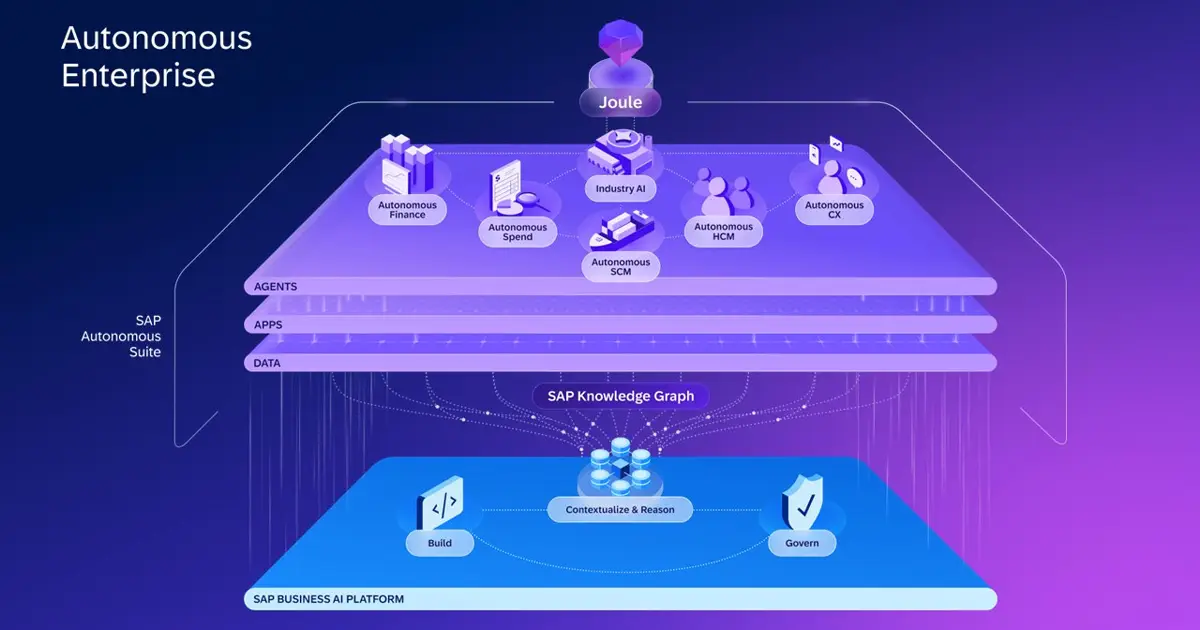
SAP uses the term Autonomous Enterprise. Is it really just a new name for AI agents?
– No, AI agents are an important part, but they are not the vision itself.
An AI agent can solve a specific multi-step task and possesses deep process knowledge. Autonomous Enterprise is about something much bigger – about how data, business processes, business applications, and AI interact in a cohesive operation. That’s why SAP talks about a vision rather than a product. SAP’s goal is not to create more AI functions per se, but to enable customers to make better decisions, react faster to changes, and automate significantly more workflows than before with the help of AI that truly understands data and processes.
SAP has also made several strategic acquisitions in recent years. How do they fit into this development?
– Very clearly. SAP has been consistent.
Signavio helps companies understand and optimize their business processes. LeanIX provides a holistic view of the application landscape and how different systems are connected. WalkMe helps users work efficiently in systems and simplifies change journeys. Over the past year, SAP has also strengthened its data platform through Dremio and its AI expertise through Prior Labs.
Each acquisition solves different parts of the puzzle. But together, they build the foundation required for AI to create real business value. An AI agent needs to understand processes, have access to the right data, know the company’s system environment, and be able to interact with the user. These are precisely the capabilities SAP is building.
What does this concretely mean for SAP customers?
– I think many believe that AI is primarily about new features. But the big change is actually about how companies work with their data and processes.
AI amplifies both strengths and weaknesses. If you have standardized processes, high data quality, and a modern platform such as S/4HANA, Business Data Cloud, and a well-thought-out Clean Core strategy, there is enormous potential. But if processes are fragmented or data is flawed, AI will also yield poorer results.
Therefore, Business Transformation is no longer just about implementing a new ERP system. It’s about creating the right conditions for AI to deliver real business value.
If you were to give advice to companies that want to benefit from this development – what would it be?
– Don’t wait for the perfect AI strategy. Start with the business.
Consider which processes take the most time, where decision-making is slowed down, and where employees spend a disproportionate amount of time on manual work. That’s often where AI has the greatest impact.
At the same time, you need to continue investing in what might not sound as exciting – data quality, process harmonization, and Clean Core. These are the investments that determine how much value the company will actually be able to get from next-generation AI.
If we meet again in three years – what do you think will have changed most in how companies use their ERP systems?
– I think we will talk less about the ERP system itself and much more about business outcomes, while I have great respect for the change journey it entails for many customers currently working with older versions of SAP.
Employees will no longer need to know exactly where information is located or which transaction to use. Instead, they will describe the business goal they want to achieve – for example, improving cash flow, reducing inventory levels, or analyzing the profitability of a product line – and AI agents will collect information, suggest actions, and perform large parts of the work under the employee’s oversight & control.
I also believe we will see ERP systems in a whole new light. Previously, it was primarily a system where people worked. Going forward, it will shift towards a system that works together with people – and in some cases, even for them.
That’s essentially what Autonomous Enterprise is all about.