


Why SAP BDC is the right path forward if you have SAP
With the introduction of SAP Business Data Cloud, SAP has embarked on a path that represents many changes compared to previous generations of SAP solutions for data and analytics. First, we must clarify that SAP Business Data Cloud is not a product but rather a framework. This framework consists of various SAP components, both familiar ones like SAC, SAC Planning, and Datasphere, as well as several new ones such as SAP Intelligent Apps, SAP data products, and SAP Business AI and Joule. These components also include integration with third-party products such as Databricks and Snowflake.
This creates an architecture that is open to the outside world and other data platforms in a way that has not been the case before. The part of SAP BDC that SAP calls SAP Business Data Fabric also enables you to achieve data from different sources that is understandable and integrated in a completely different way than before, and can therefore be used by the business without the need for IT expertise. The governance model that comes with SAP BDC also enables good control over data integration, loads, distribution, and access to data.
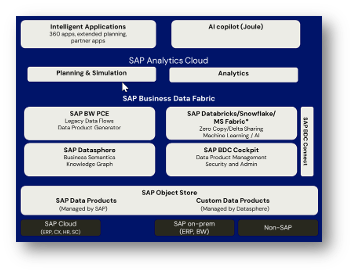
Finally, the consumption of SAP BDC is scalable, which means you only pay for the actual consumption you have. This makes it economically defensible to run SAP BDC side by side with SAP Business Warehouse 7.5 or other similar legacy platforms you are using during a transition period.
Why SAP BW is no longer enough
SAP Business Warehouse 7.5 was built for a different era. It was, at the time of its launch, a very competent data warehouse solution that became even more powerful when HANA storage technology was introduced. But fundamentally, it is based on batch processing of data, extensive programming using ABAP/4, and semantics locked into InfoCubes and DSOs. It has worked (and still works) well, but it becomes a bottleneck when you want to achieve near-real-time transparency, combine SAP and non-SAP data, and use AI and ML in daily operations. Additionally, the product is no longer being developed, and SAP has announced an end of life by 2027, with possible extension of support for a few more years at an additional cost.
Transition at your own pace. What does that mean in practice ?
Having the ability to change and move at your own pace is a very important difference between a good and a bad modernization program. In a good program, you can plan for coexistence between old and new, you can tackle area by area, and you can continuously benefit from actual lessons learned as the program progresses.
Key concepts are side by side, taking many steps toward a long-term goal, time for alignment and change, and clear milestones. You can accelerate the work and achieve quick wins by using accelerators and templates where possible. By prototyping and showing quick results within a specific area that you can visualize and share with the business, you can successively refine and improve in iterations. This wins the business’s trust and acceptance. By also addressing data quality in source systems, you can make improvements for the future.
Three common pitfalls and how to avoid them:
1. Legacy solutions and logic that no one dares to touch
InfoCubes, DSOs, and batch jobs in SAP BW are often tightly coupled to business logic and are often programmed with different steps during the ETL process. They cannot be “converted directly” to a modern model in SAP Business Data Cloud.
Countermeasure: Start with a pilot that is actually used by the business. Choose a data area (e.g., sales analytics), find a good template among those offered by SAP, and populate it with data using understandable and integrated standard content. Use the model for comparison with the current state, identify data or dimensions that do not match, understand what causes the differences, and address them after an active decision. Reload and make new comparisons. Focus primarily on the data model and not so much on the user interface—that comes later and becomes easier when the data is correct. Be open to questioning old truths and take the opportunity to get it right at the source to avoid building new logic to correct faulty data.
2. Integration of non-SAP data becomes a bonus
A major value of a modern platform lies in the ability to work with both SAP data and other data, to integrate data into understandable models that give the business the analytical perspectives it needs. This further increases the value of your SAP data. If integration is not well thought out from the start, you easily end up with data in silos or data that is not easy to build context around (disjointed insights).
Countermeasure: Define early which source systems and what data you want to combine and how the logical connections look. Design analytical models that combine data and can be used to later create clear data products that can be shared in the ecosystem if needed. Also consider where you want to consume your data. In SAP tools like SAC, share it with Databricks, or make it easily accessible for other tools.
3. Learning the new—the business loses patience
When moving from BEx Web, AfO, and other analytical tools on top of SAP BW to more self-service and new tools, users can easily fall back to “the old way” and request previous solutions. This is often reinforced if you also change and simplify data models and formulas. This is one of the most common obstacles to effective migrations.
Countermeasure: Always start by inventorying and finding analyses and reports that are actually used. Create clear subsets per area with reports that are actually used. Find overlaps, duplicates, and get help from the business in this mapping. Also take the opportunity to request desired improvements and other feedback on current solutions. Include the same representatives in the development of new data models and analytical tools, run training and alignment as part of the program. Clarify differences between then and now.
A checklist for SAP BW 7.5 to Business Data Cloud:
Step 1. Decide what must be true for you to succeed
- Which decisions should be faster. Which teams should improve.
- What level of real-time is required.
- Identify and classify risks within internal and external reporting, regulatory requirements, and others.
Step 2. Inventory the reality in BW
- Which reports are actually used. Top 20 per area.
- Which objects carry business-critical logic.
- Where is the hidden code and logic that no one knows about.
- How many solutions are built on the use of SAP Integrated Planning as part of SAP BW
- Which reports can today be supported in other ways, e.g., by using Embedded Analytics in SAP S/4HANA
Step 3. Choose a pilot that forces the right learnings
- Select a data domain with clear ownership in the business and a willingness to be first.
- Set goals for the pilot. Time to first value, improved data quality, success factors.
- Describe what is required to be complete and for the corresponding parts of BW to be shut down.
Step 4. Work in a loop, area by area
- Hybrid and step-by-step allows you to standardize the approach.
- Identify template, extract, load model, compare with current state, find delta, update models and reports
- Continuously move to production and phase out BW for that part.
Step 5. Ensure governance and cost control
- Business Data Cloud is an open ecosystem. It requires good control over data sharing and access.
- Understand and apply authorization models and how to track data and who can see what
- Create clear ownership for the content in data models, who is responsible and who determines the definitions of data and KPIs.
- Consumption model—what drives costs in SAP BDC and who pays for the different parts?
FAQ – Questions CIOs typically ask
What does “modernize at your own pace” mean concretely?
Hybrid and coexistence. You choose what moves first, and phase out SAP BW step by step.
Do we have to choose between SAP BDC or another data platform, e.g., Snowflake?
No, the direction is rather to connect them. SAP emphasizes integration with partners and an open ecosystem.
Why does everyone talk about pilot first?
Because SAP BW structures and batch logic rarely can be “moved as they are.” A pilot provides quick feedback and reduces risk. A pilot enables you to evaluate and learn to work with the components in SAP BDC for the future. Additionally, many SAP BW installations contain solutions developed 10-15 years ago that may not be what you need for the future. A pilot can have some freedom to think differently.
Summary: A smarter way to think about BW exit.
If you do not choose to move an existing SAP BW to a Private Cloud instance within SAP BDC and run it as-is for a few more years, the best SAP BW 7.5 strategy is to implement a controlled modernization and migration to SAP BDC, step by step and side by side. There you can chart the path toward a modern platform with integrated and understandable data that is AI-ready, without losing control. You move what delivers business value first. You standardize incrementally. You drive adoption as hard as technology.
And you build a position where SAP data can be used where it fits best. In SAP’s tools, or in data platforms like Snowflake, Databricks, and MS Fabric, with governance and semantics intact.
Want to see how your journey from SAP BW 7.5 to SAP Business Data Cloud can be taken step by step.
Book an SAP BDC Workshop with Implema